


Incoloy 825 Nickel-based alloy
Incoloy 825
Quantity:
Incoloy 825
Data grade: Incoloy 825 nickel-based alloy
United States grade: UNS NO8825
German grade: WN r.2.4858
Chinese grade: NS142
1. Overview of Incoloy825 (N08825, 2.4858) nickel-based alloy:
Incoloy825 (N08825, 2.4858) nickel-based alloy is a fully austenitic nickel-iron-chromium alloy with titanium stabilization treatment, and copper and molybdenum are added. Incoloy825 has the following features:
1. Excellent resistance to stress corrosion cracking.
2. Excellent resistance to pitting and crevice corrosion.
3. Good antioxidant and non-oxidative thermal acid performance.
4. It has good mechanical performance at room temperature and at high temperatures up to 550℃.
5. Certification for manufacturing pressure vessels with temperatures up to 450°C.
2. Chemical composition of Incoloy825 (N08825, 2.4858) nickel-based alloy: %
Data grade: Incoloy 825 nickel-based alloy
United States grade: UNS NO8825
German grade: WN r.2.4858
Chinese grade: NS142
1. Overview of Incoloy825 (N08825, 2.4858) nickel-based alloy:
Incoloy825 (N08825, 2.4858) nickel-based alloy is a fully austenitic nickel-iron-chromium alloy with titanium stabilization treatment, and copper and molybdenum are added. Incoloy825 has the following features:
1. Excellent resistance to stress corrosion cracking.
2. Excellent resistance to pitting and crevice corrosion.
3. Good antioxidant and non-oxidative thermal acid performance.
4. It has good mechanical performance at room temperature and at high temperatures up to 550℃.
5. Certification for manufacturing pressure vessels with temperatures up to 450°C.
2. Chemical composition of Incoloy825 (N08825, 2.4858) nickel-based alloy: %
| C ≤ | Si ≤ | Mn ≤ | P ≤ | S ≤ | CR ≥ | Ni≥ | Mo ≥ | CU ≤ |
| 0.05 | 0.50 | 1.00 | 0.035 | 0.030 | 19.5-23.5 | 38.0-46.0 | 2.5-3.5 | 1.5-3.0 |
| other | N≤ | Al≤ | TI ≤ | FE ≤ | CO ≤ | V ≤ | W ≤ | Nb ≤ |
| - | 0.20 | 0.6-1.2 | Remain | - | - | - | - |
3. Incoloy825 (N08825, 2.4858) nickel-based alloy execution standards:
| product | ASTM | |||||||
| bar and bar | B 425 | |||||||
| Middle thick plates, thin plates and band materials | B 424, B 906 | |||||||
| Seamless pipes and parts | B 423, B 829 | |||||||
| Welding nominal tube | B 705, B 775 | |||||||
| Welding pipes | B 704, B 751 | |||||||
| Welding pipeline | B 366 | |||||||
| Forged | B 564 | |||||||
| 4. Physical properties of Incoloy825 (N08825, 2.4858) nickel-based alloy: | ||||||||
| 1. Density: ρ=8.1g/cm3. | ||||||||
| 2. Melting temperature range: 1370-1400℃. | ||||||||
| Temperature ℃ | Specific heat capacity J/Kg K | Thermal conductivity W/mK | Resistivity uQcm | Elastic modulus KN/mm2 | Thermal expansion coefficient 10-6/K | |||
| 20 | 440 | 10.8 | 112 | 195 | ||||
| 93 | ||||||||
| 100 | 462 | 12.4 | 114 | 190 | 14.1 | |||
| 200 | 488 | 14.1 | 118 | 185 | 14.9 | |||
| 204 | ||||||||
| 300 | 514 | 15.6 | 120 | 179 | 15.2 | |||
| 316 | ||||||||
| 400 | 540 | 16.9 | 124 | 174 | 15.6 | |||
| 427 | ||||||||
| 500 | 565 | 18.3 | 126 | 168 | 15.8 | |||
| 538 | ||||||||
| 600 | 590 | 19.6 | 126 | 161 | 16.0 | |||
| 649 | ||||||||
| 700 | 615 | 21.0 | 127 | 154 | 16.7 | |||
| 760 | ||||||||
| 800 | 655 | 23.2 | 128 | 142 | 17.2 | |||
| 871 | ||||||||
| 900 | 680 | 25.7 | 129 | 130 | 17.6 | |||
| 982 | ||||||||
| 1000 | 710 | 28.1 | 130 | 119 | 17.9 | |||
5. Mechanical performance of Incoloy825 (N08825, 2.4858) nickel-based alloy:
The properties listed in the table below apply to the conditions after softening annealing (stable annealing) of the specified specifications of Incoloy825 alloy. The special effects of non-standard size data can be provided according to the requirements of a specific application.
1. Room temperature mechanical performance (minimum value):
The properties listed in the table below apply to the conditions after softening annealing (stable annealing) of the specified specifications of Incoloy825 alloy. The special effects of non-standard size data can be provided according to the requirements of a specific application.
1. Room temperature mechanical performance (minimum value):
| product | Size mm | Yield of yield RP0.2 N/mm2 | Yield of yield RP1.0 N/mm3 | tensile strength Rm N/mm2 | Extension A50% | |||
| Thin sheet strip/cold rolling Plate/hot rolling | 0.5-6.4 | 240 | 265 | 585 | 30 | |||
| 5-100 | ||||||||
| Macaron Cold processing Hot processing | 1.6-64 | |||||||
| 25-100 | ||||||||
| >100-240 | 220 | 250 | 550 | 35 | ||||
| Pipe Cold processing Hot processing | 64-240 | 180 | - | 530 | 30 | |||
| 5-100 | 240 | 265 | 585 | 30 | ||||
| Condensing and heat exchangers | 16-76 | |||||||
| 2. Room temperature mechanical properties (minimum value): | ||||||||
| product | Yield of yield RP0.2 N/mm2 | Yield of yield RP1.0 N/mm3 | ||||||
| Temperature ℃ | 100 | 200 | 300 | 400 | 100 | 200 | 300 | 400 |
| Board, belt, tube | 205 | 180 | 170 | 160 | 235 | 205 | 195 | 185 |
| Great | 190 | 165 | 155 | 145 | 220 | 190 | 180 | 170 |
| 3. Incoloy825 (N08825, 2.4858) ISO V-shaped notch impact test: | ||||||||
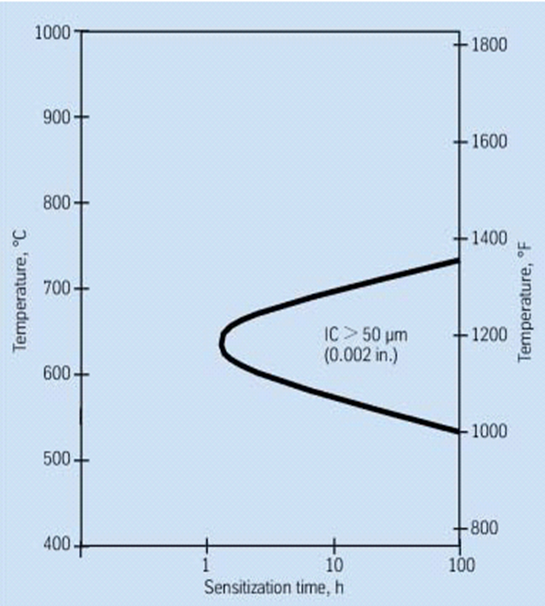
| Average room temperature: axial direction >=150J/cm2, radial direction >=100J/cm2, time-temperature-sensitization curve. | ||||||||
 | ||||||||
4. Incoloy825 (N08825, 2.4858) nickel-based alloy conditional stress value:
High condition stress values reaching 90% yield strength can be applied to applications where slightly larger deformations are allowed. Permanent stresses caused by these stresses can cause dimensional changes, which are not recommended for flange and sealing gasket connectors.
5. Incoloy825 (N08825, 2.4858) nickel-based alloy metallographic structure:
Incoloy825 alloy has a stable face-centered cubic structure. Chemical composition and proper heat treatment ensure that corrosion resistance is not weakened by sensitization.
6. Corrosion resistance of Incoloy825 (N08825, 2.4858) nickel-based alloy:
Incoloy825 is a universal engineering alloy that has anti-acid and alkali metal corrosion performance in both oxidation and reduction conditions. The high nickel component makes the alloy effective resistance to stress corrosion cracking. The corrosion resistance is good in various media, such as sulfuric acid, phosphoric acid, nitric acid and organic acids, alkali metals such as sodium hydroxide, potassium hydroxide and hydrochloric acid solutions. The high comprehensive performance of Incoloy825 is reflected in nuclear combustion dissolvers with various corrosive media, such as sulfuric acid, nitric acid and sodium hydroxide, all processed in the same equipment.
6. Incoloy825 (N08825, 2.4858) nickel-based alloy processing and heat treatment:
Incoloy825 alloy is easy to process in general industrial processes.
1. Incoloy825 (N08825, 2.4858) nickel-based alloy preheating:
Temperature control is very important to ensure that the corrosion resistance of the alloy is not weakened by sensitization. The workpiece must be surface cleaned before and during heating to keep the surface clean. If the heating environment contains sulfur, phosphorus, lead or other low melting point metals, Nicrofer 6023/6023H alloy will become brittle. Impurities come from labeled paint, chalk, lubricating oil, water, fuel, etc. The sulfur content of fuel should be low, such as the impurity content of liquefied gas and gas should be less than 0.1%, the sulfur content of urban gas should be less than 0.25g/m3, and the sulfur content of petroleum gas should be less than 0.5%.
The heat treatment is preferably carried out in a vacuum electric furnace or an inert gas protective atmosphere, as this allows precise temperature control and no contamination from impurities. If the gas impurity content is low, you can also use a natural gas heating furnace, so that a neutral or weak oxidative atmosphere can be obtained. The furnace gas components should be avoided from fluctuating in oxidative and reducing properties, but the fire filling cannot be directly burned to the workpiece.
2. Incoloy825 (N08825, 2.4858) nickel-based alloy hot processing:
The suitable hot processing temperature for Incoloy825 alloy is 1150-900°C, and the cooling pipes can be water quenched or fast air-cooled. During hot processing, the workpiece can be directly fed to the furnace that has reached the temperature. After the furnace reaches temperature, the insulation time of the data is 60 minutes per 100mm thickness. The oven is immediately released after the insulation has reached the specified time and processed within the specified temperature range. If the temperature of the metal drops below the minimum processing temperature, it should be heated again. After hot processing, it should be annealed in time to ensure the best corrosion resistance and suitable crystal structure.
3. Incoloy825 (N08825, 2.4858) nickel-based alloy cold processing:
Cold processing should be carried out after solid solution treatment, the work hardening rate of Incoloy825 is close to that of austenitic stainless steel, and the processing equipment should be adjusted accordingly. When the cold processing volume is large, there should be an intermediate annealing process. When the final cold deformation amount is greater than 15%, the final stabilization treatment is required.
4. Incoloy825 (N08825, 2.4858) nickel-based alloy heat treatment:
The temperature range of softening annealing or stabilization treatment is 920-980°C, and most suitable is 940±10°C. For workpieces with thicknesses greater than 1.5mm, water quenching or rapid air cooling is recommended to obtain maximum creep resistance. During any heat treatment process, pay attention to the aforementioned matters regarding keeping clean.
5. Incoloy825 (N08825, 2.4858) nickel-based alloy grinding and pickling:
The oxide near the welds of the Incoloy825 workpiece is more difficult to remove than those of stainless steel and needs to be polished with fine sanding belts or grinding wheels. To maintain the metallic luster, be very careful when polishing. Before pickling in a mixed acid of nitric acid and hydrofluoric acid, the oxides should also be removed with sandpaper or pretreated for salt bath. Pay special attention to the pickling time
6. Incoloy825 (N08825, 2.4858) nickel-based alloy processing:
The machining of Incoloy825 needs to be carried out after solid solution treatment. Taking into account the work hardening properties of the data, unlike austenitic stainless steel, low surface cutting speed and heavy injection volume are required.
7. Incoloy825 (N08825, 2.4858) nickel-based alloy welding:
1. When welding nickel-based alloys, the following procedures should be followed:
(1) Workplace: The workplace should be separated separately or at a sufficient distance from the processing area of carbon steel, keep it as clean as possible, and install partitions to avoid ventilation between the two areas.
(2) Work clothes and auxiliary supplies: Wear clean fine-line leather gloves and clean work clothes.
(3) Tools and machinery and equipment: There should be special tools for nickel-based alloys and nickel-chromium steel. The wire brush should be made of stainless steel material. Machinery and equipment such as shearing machines, punching machines, rolling mills, etc. should be covered with felt, cardboard or plastic. Paper prevents iron and carbon metal from falling on the surface of the machine, causing processing materials to stick to, resulting in corrosion. Remove the scale, oil and various mark marks, and use acetone to clean the matrix metal and fill alloys (such as welding rods) in the welding area. Be careful not to use trichloroethylene TRI, perchloroethylene PER and tetrachloride TETRA."
2. Incoloy825 edge preparation:
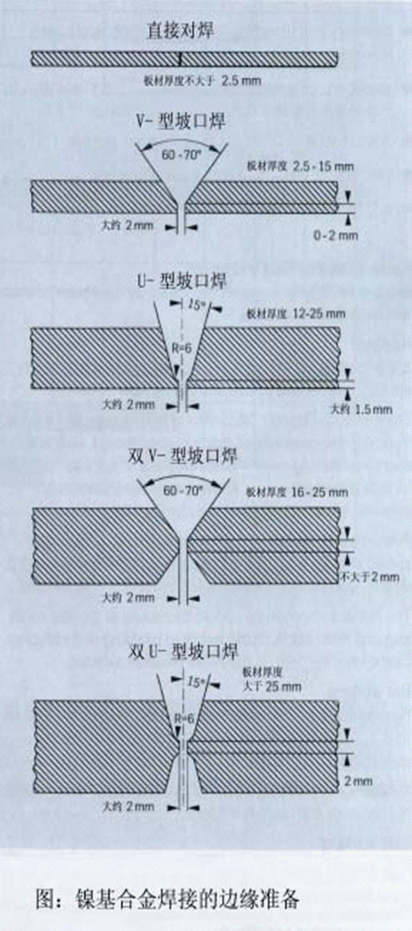
It is best to use machining such as turning, milling, and planing, or plasma cutting. If the latter is used, the cutting edge (welding surface) must be ground cleanly and smoothly, allowing for fine grinding that is not hot. The area of the base material on both sides of the weld should be polished to reveal bright metal.
3. Incoloy825 bevel angle:
Compared with carbon steel, the physical properties of nickel-based alloys and special stainless steels are mainly low thermal conductivity and high coefficient of expansion. These characteristics must be considered when preparing welding bevels, including widening the bottom gap (1 ~3mm), and at the same time, due to the viscosity of molten metal, a larger bevel angle (60~70°) should be used during butt welding to offset the shrinkage of the data.
4. Incoloy825 arc start:
Arcs cannot be made on the surface of the workpiece, but arcs should be made on the welding surface to prevent corrosion caused by arc starting point.
5. Incoloy825 welding process:
(1) lncoloy825 is suitable for welding with the same materials or other metals using any traditional welding process, such as tungsten electrode inert gas protection welding, plasma arc welding, manual sub-arc welding, metal extremely inert gas protection welding, melt extremely inert gas protection welding, melt extremely inert gas protection welding, , among which pulse arc welding is the preferred solution. When using manual arc welding, it is recommended to use protective gas mixed with multiple components (Ar+He+H2+CO2).
(2) | ncolov825 welding must be carried out in an annealed state, and a stainless steel wire brush must be used to clean the stains, dust and name marks. When welding the weld roots, in order to obtain the best root weld quality, very careful operation must be performed (argon 99.99), so that no oxide is produced in the weld after the root weld is welded. The color generated by the welding heat-affected zone should be brushed with a stainless steel brush when the weld area has not cooled.
(3) lncoloy825 filled metal: welding rod: ENiCrMo-3, welding wire: ERNiCrMo-3.
6. Incoloy825 welding parameters and influence (heat input):
The welding operation should be carried out under the low heat input specified in the heat input table. Bead weld technology is adopted. The temperature between layers shall not exceed 120℃ and the welding specifications must be followed. The input Q of the heat is calculated according to the following formula:
High condition stress values reaching 90% yield strength can be applied to applications where slightly larger deformations are allowed. Permanent stresses caused by these stresses can cause dimensional changes, which are not recommended for flange and sealing gasket connectors.
5. Incoloy825 (N08825, 2.4858) nickel-based alloy metallographic structure:
Incoloy825 alloy has a stable face-centered cubic structure. Chemical composition and proper heat treatment ensure that corrosion resistance is not weakened by sensitization.
6. Corrosion resistance of Incoloy825 (N08825, 2.4858) nickel-based alloy:
Incoloy825 is a universal engineering alloy that has anti-acid and alkali metal corrosion performance in both oxidation and reduction conditions. The high nickel component makes the alloy effective resistance to stress corrosion cracking. The corrosion resistance is good in various media, such as sulfuric acid, phosphoric acid, nitric acid and organic acids, alkali metals such as sodium hydroxide, potassium hydroxide and hydrochloric acid solutions. The high comprehensive performance of Incoloy825 is reflected in nuclear combustion dissolvers with various corrosive media, such as sulfuric acid, nitric acid and sodium hydroxide, all processed in the same equipment.
6. Incoloy825 (N08825, 2.4858) nickel-based alloy processing and heat treatment:
Incoloy825 alloy is easy to process in general industrial processes.
1. Incoloy825 (N08825, 2.4858) nickel-based alloy preheating:
Temperature control is very important to ensure that the corrosion resistance of the alloy is not weakened by sensitization. The workpiece must be surface cleaned before and during heating to keep the surface clean. If the heating environment contains sulfur, phosphorus, lead or other low melting point metals, Nicrofer 6023/6023H alloy will become brittle. Impurities come from labeled paint, chalk, lubricating oil, water, fuel, etc. The sulfur content of fuel should be low, such as the impurity content of liquefied gas and gas should be less than 0.1%, the sulfur content of urban gas should be less than 0.25g/m3, and the sulfur content of petroleum gas should be less than 0.5%.
The heat treatment is preferably carried out in a vacuum electric furnace or an inert gas protective atmosphere, as this allows precise temperature control and no contamination from impurities. If the gas impurity content is low, you can also use a natural gas heating furnace, so that a neutral or weak oxidative atmosphere can be obtained. The furnace gas components should be avoided from fluctuating in oxidative and reducing properties, but the fire filling cannot be directly burned to the workpiece.
2. Incoloy825 (N08825, 2.4858) nickel-based alloy hot processing:
The suitable hot processing temperature for Incoloy825 alloy is 1150-900°C, and the cooling pipes can be water quenched or fast air-cooled. During hot processing, the workpiece can be directly fed to the furnace that has reached the temperature. After the furnace reaches temperature, the insulation time of the data is 60 minutes per 100mm thickness. The oven is immediately released after the insulation has reached the specified time and processed within the specified temperature range. If the temperature of the metal drops below the minimum processing temperature, it should be heated again. After hot processing, it should be annealed in time to ensure the best corrosion resistance and suitable crystal structure.
3. Incoloy825 (N08825, 2.4858) nickel-based alloy cold processing:
Cold processing should be carried out after solid solution treatment, the work hardening rate of Incoloy825 is close to that of austenitic stainless steel, and the processing equipment should be adjusted accordingly. When the cold processing volume is large, there should be an intermediate annealing process. When the final cold deformation amount is greater than 15%, the final stabilization treatment is required.
4. Incoloy825 (N08825, 2.4858) nickel-based alloy heat treatment:
The temperature range of softening annealing or stabilization treatment is 920-980°C, and most suitable is 940±10°C. For workpieces with thicknesses greater than 1.5mm, water quenching or rapid air cooling is recommended to obtain maximum creep resistance. During any heat treatment process, pay attention to the aforementioned matters regarding keeping clean.
5. Incoloy825 (N08825, 2.4858) nickel-based alloy grinding and pickling:
The oxide near the welds of the Incoloy825 workpiece is more difficult to remove than those of stainless steel and needs to be polished with fine sanding belts or grinding wheels. To maintain the metallic luster, be very careful when polishing. Before pickling in a mixed acid of nitric acid and hydrofluoric acid, the oxides should also be removed with sandpaper or pretreated for salt bath. Pay special attention to the pickling time
6. Incoloy825 (N08825, 2.4858) nickel-based alloy processing:
The machining of Incoloy825 needs to be carried out after solid solution treatment. Taking into account the work hardening properties of the data, unlike austenitic stainless steel, low surface cutting speed and heavy injection volume are required.
7. Incoloy825 (N08825, 2.4858) nickel-based alloy welding:
1. When welding nickel-based alloys, the following procedures should be followed:
(1) Workplace: The workplace should be separated separately or at a sufficient distance from the processing area of carbon steel, keep it as clean as possible, and install partitions to avoid ventilation between the two areas.
(2) Work clothes and auxiliary supplies: Wear clean fine-line leather gloves and clean work clothes.
(3) Tools and machinery and equipment: There should be special tools for nickel-based alloys and nickel-chromium steel. The wire brush should be made of stainless steel material. Machinery and equipment such as shearing machines, punching machines, rolling mills, etc. should be covered with felt, cardboard or plastic. Paper prevents iron and carbon metal from falling on the surface of the machine, causing processing materials to stick to, resulting in corrosion. Remove the scale, oil and various mark marks, and use acetone to clean the matrix metal and fill alloys (such as welding rods) in the welding area. Be careful not to use trichloroethylene TRI, perchloroethylene PER and tetrachloride TETRA."
2. Incoloy825 edge preparation:
It is best to use machining such as turning, milling, and planing, or plasma cutting. If the latter is used, the cutting edge (welding surface) must be ground cleanly and smoothly, allowing for fine grinding that is not hot. The area of the base material on both sides of the weld should be polished to reveal bright metal.
3. Incoloy825 bevel angle:
Compared with carbon steel, the physical properties of nickel-based alloys and special stainless steels are mainly low thermal conductivity and high coefficient of expansion. These characteristics must be considered when preparing welding bevels, including widening the bottom gap (1 ~3mm), and at the same time, due to the viscosity of molten metal, a larger bevel angle (60~70°) should be used during butt welding to offset the shrinkage of the data.
4. Incoloy825 arc start:
Arcs cannot be made on the surface of the workpiece, but arcs should be made on the welding surface to prevent corrosion caused by arc starting point.
5. Incoloy825 welding process:
(1) lncoloy825 is suitable for welding with the same materials or other metals using any traditional welding process, such as tungsten electrode inert gas protection welding, plasma arc welding, manual sub-arc welding, metal extremely inert gas protection welding, melt extremely inert gas protection welding, melt extremely inert gas protection welding, , among which pulse arc welding is the preferred solution. When using manual arc welding, it is recommended to use protective gas mixed with multiple components (Ar+He+H2+CO2).
(2) | ncolov825 welding must be carried out in an annealed state, and a stainless steel wire brush must be used to clean the stains, dust and name marks. When welding the weld roots, in order to obtain the best root weld quality, very careful operation must be performed (argon 99.99), so that no oxide is produced in the weld after the root weld is welded. The color generated by the welding heat-affected zone should be brushed with a stainless steel brush when the weld area has not cooled.
(3) lncoloy825 filled metal: welding rod: ENiCrMo-3, welding wire: ERNiCrMo-3.
6. Incoloy825 welding parameters and influence (heat input):
The welding operation should be carried out under the low heat input specified in the heat input table. Bead weld technology is adopted. The temperature between layers shall not exceed 120℃ and the welding specifications must be followed. The input Q of the heat is calculated according to the following formula:
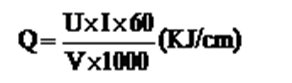 | U=arc voltage, volt I=welding current, ampere V=welding speed, centimeters/min. | |||
7. Incoloy825 post-welding treatment (pickling, brushing oxide removal and heat treatment):
After welding, the oxide should be removed with a stainless steel wire brush immediately, that is, brush it when the metal has not yet produced a welding color, so that the ideal surface quality can be obtained without pickling. If there are no special requirements or regulations, pickling is usually the last step in welding, please refer to the sections of de-oxidation and pickling. No heat treatment is required before and after welding.
Heat input for tissue length (guidance value):
After welding, the oxide should be removed with a stainless steel wire brush immediately, that is, brush it when the metal has not yet produced a welding color, so that the ideal surface quality can be obtained without pickling. If there are no special requirements or regulations, pickling is usually the last step in welding, please refer to the sections of de-oxidation and pickling. No heat treatment is required before and after welding.
Heat input for tissue length (guidance value):
| Welding process | Heat input per unit length kJ/cm | Welding process | Heat input per unit length kJ/cm | |||||
| GTAW, manual/full mechanized | ≤10 | MIG/MAG, manual/full mechanized | ≤11 | |||||
| Hot Wire GTAW | ≤6 | Manual arc welding (SMAW) | ≤7 | |||||
| Plasma arc | ≤10 | |||||||
8. Application scope of Incoloy825 (N08825, 2.4858) nickel-based alloy:
Incoloy825 is widely used in various industrial fields where the temperature is not more than 550℃. Typical applications are:
1. Heating pipes, containers, baskets and chains for sulfuric acid pickling factories.
2. Seawater cooling heat exchanger, marine product pipeline system, acid gas environmental pipeline.
3. Heat exchangers, evaporators, washing, impregnation tubes, etc. in phosphoric acid production.
4. Air heat exchanger in petroleum refining.
5. Food engineering.
6. Chemical process.
7. Flame retardant alloys used in high-pressure oxygen.
9. Type specifications and supply status of Incoloy825 (N08825, 2.4858) nickel-based alloy:
Shanghai Disheng Special Alloy can produce various specifications of Incoloy825 seamless pipes, Incoloy825 steel plates, Incoloy825 round steel, Incoloy825 forgings, Incoloy825 flanges, Incoloy825 rings, Incoloy825 welded pipes, Incoloy825 Steel belt, Incoloy825 wire and supporting welding materials.
Incoloy825 is widely used in various industrial fields where the temperature is not more than 550℃. Typical applications are:
1. Heating pipes, containers, baskets and chains for sulfuric acid pickling factories.
2. Seawater cooling heat exchanger, marine product pipeline system, acid gas environmental pipeline.
3. Heat exchangers, evaporators, washing, impregnation tubes, etc. in phosphoric acid production.
4. Air heat exchanger in petroleum refining.
5. Food engineering.
6. Chemical process.
7. Flame retardant alloys used in high-pressure oxygen.
9. Type specifications and supply status of Incoloy825 (N08825, 2.4858) nickel-based alloy:
Shanghai Disheng Special Alloy can produce various specifications of Incoloy825 seamless pipes, Incoloy825 steel plates, Incoloy825 round steel, Incoloy825 forgings, Incoloy825 flanges, Incoloy825 rings, Incoloy825 welded pipes, Incoloy825 Steel belt, Incoloy825 wire and supporting welding materials.
| Variety classification | Delivery status | |||||||
| Seamless tube | Soluble+acid white, the length can be fixed | |||||||
| Plate | Soluble, pickled, cut edges | |||||||
| Welding pipe | Solid -soluble acid white+RT%probe | |||||||
| Forged | Antuction+car light | |||||||
| Macaron | Forging rolling state, surface polishing or car light | |||||||
| Band material | Cold rolling, solid -soluble soft state, de -oxide leather delivery | |||||||
| Silk material | Solid -soluble acid dishwashing or straight strip -shaped, solid -soluble straight strip fine polishing state delivery | |||||||
| Note: Incoloy™ is a registered trademark of Special Metal Group Corporation. | ||||||||


