


Nickel-based superalloy 625
Inconel625
Quantity:
Inconel625
Data grade: Inconel625 nickel-based high-temperature alloy
American brand: UNS NO6625
Chinese brand: GH3625/GH625
French brand: NC22DNb
German brand: W.Nr.2.4856
1. Overview of Inconel625 (NO6625) nickel-based high-temperature alloy:
Inconel625 is a solid solution strengthened nickel-based deformed high-temperature alloy with molybdenum and niobium as the main strengthening elements. It has excellent corrosion resistance and oxidation resistance. It has good tensile performance and fatigue performance from low temperature to 980℃, and is resistant to Stress corrosion in salt spray atmosphere. Therefore, it can be widely used in the manufacture of aircraft engine components, aviation structural components and chemical equipment. The alloy has good processing and welding properties and can be supplied in a variety of plates, bars, tubes, wires, strips and forgings.
2. Chemical composition of Inconel625 (NO6625) nickel-based high-temperature alloy: %
Data grade: Inconel625 nickel-based high-temperature alloy
American brand: UNS NO6625
Chinese brand: GH3625/GH625
French brand: NC22DNb
German brand: W.Nr.2.4856
1. Overview of Inconel625 (NO6625) nickel-based high-temperature alloy:
Inconel625 is a solid solution strengthened nickel-based deformed high-temperature alloy with molybdenum and niobium as the main strengthening elements. It has excellent corrosion resistance and oxidation resistance. It has good tensile performance and fatigue performance from low temperature to 980℃, and is resistant to Stress corrosion in salt spray atmosphere. Therefore, it can be widely used in the manufacture of aircraft engine components, aviation structural components and chemical equipment. The alloy has good processing and welding properties and can be supplied in a variety of plates, bars, tubes, wires, strips and forgings.
2. Chemical composition of Inconel625 (NO6625) nickel-based high-temperature alloy: %
| C≤ | Si≤ | Mn≤ | P≤ | S≤ | Cr≥ | Ni≥ | Mo≥ | Cu≤ |
| 0.10 | 0.50 | 0.50 | 0.015 | 0.015 | 20.0-23.0 | Remain | - | 0.07 |
| other | N≤ | Al≤ | Ti≤ | Fe≤ | Co≤ | V≤ | W≤ | Nb≤ |
| - | 0.40 | 0.40 | 5.00 | 1.00 | - | - | 3.15-4.15 |
3. Inconel625 (NO6625) nickel-based high-temperature alloy implementation standards:
| product | ASTM | |||||||
| Rod | B 446 | |||||||
| Plate, sheet and strip | B 443, B 906 | |||||||
| Seamless pipes and fittings | B 444, B 829 | |||||||
| welded pipe | B 705, B 775 | |||||||
| Welded pipe fittings | B 704, B 751 | |||||||
| Welded connections | B 366 | |||||||
| Forged billets and bars | B 472 | |||||||
| Forgings | B 564 | |||||||
4. Inconel625 (NO6625) nickel-based high-temperature alloy heat treatment system:
Bar: 950~1030℃, air cooling or water cooling; or 1090~1200℃, air cooling or water cooling solid solution treatment.
Plate: 950~1030℃, air cooling; or 1090~1200℃, air cooling.
Pipe material: Recommended annealing temperature is 960~1030℃, air cooling or water cooling.
5. Inconel625 (NO6625) nickel-based high-temperature alloy variety specifications and supply status:
We can supply d25~80mm rods and 80.8~10.5mm plates, as well as d6~40mm un(welded) pipes. Rods are delivered without heat treatment but in a polished or polished state; plates are supplied after solution and finishing; pipes are supplied after solution and pickling (or bright annealing).
6. Inconel625 (NO6625) nickel-based high-temperature alloy smelting and casting process:
The alloy is produced using vacuum induction furnace melting plus electroslag remelting or vacuum induction furnace plus vacuum arc remelting.
7. Application overview and special requirements of Inconel625 (NO6625) nickel-based high-temperature alloy:
This alloy is used to manufacture parts such as engine casings, guide vanes, mounting edges and barrels, and fuel main pipes. It has passed practical application assessments and has a maximum service temperature of 950°C; the alloy has a certain aging effect after long-term use at 550~700°C. The hardening phenomenon leads to some decrease in the plasticity of the alloy.
1. Application fields:
Low carbon alloy 625 after soft annealing is widely used in the chemical process industry. Its good corrosion resistance and high strength enable it to be used as thin structural components. Alloy 625 can be used in applications where it is exposed to seawater and is subject to high mechanical stress. Typical application areas:
(1) Parts of organic chemical processes containing chloride, especially when acidic chloride catalysts are used;
(2) Digesters and bleaching tanks used in the pulp and paper industry;
(3) Absorption tower, reheater, flue gas inlet baffle, fan (humidity), agitator, deflector and flue in the flue gas desulfurization system;
(4) Used to manufacture equipment and components used in acidic gas environments;
(5) Acetic acid and acetic anhydride reaction generator;
(6), sulfuric acid condenser.
2. Product features:
(1) It has excellent corrosion resistance against various corrosive media in oxidizing and reducing environments;
(2) Excellent resistance to pitting corrosion and crevice corrosion, and will not cause chloride ion stress corrosion cracking;
(3) Excellent resistance to inorganic acid corrosion, such as nitric acid, phosphoric acid, sulfuric acid, hydrochloric acid and mixed acids of sulfuric acid and hydrochloric acid, etc.;
(4) Excellent resistance to corrosion by various inorganic acid mixed solutions;
(5) When the temperature reaches 40°C, it can show good corrosion resistance in hydrochloric acid solutions of various concentrations;
(6) Good processability and weldability, no post-weld cracking sensitivity;
(7) Manufacturing certification for pressure vessels with wall temperatures between -196 and 450°C;
(8) It is certified by the NACE standard of the American Society of Corrosion Engineers (MR-01-75) and meets the highest standard level VII for use in sour gas environments."
8. Inconel625 (NO6625) nickel-based high-temperature alloy physical and chemical properties:
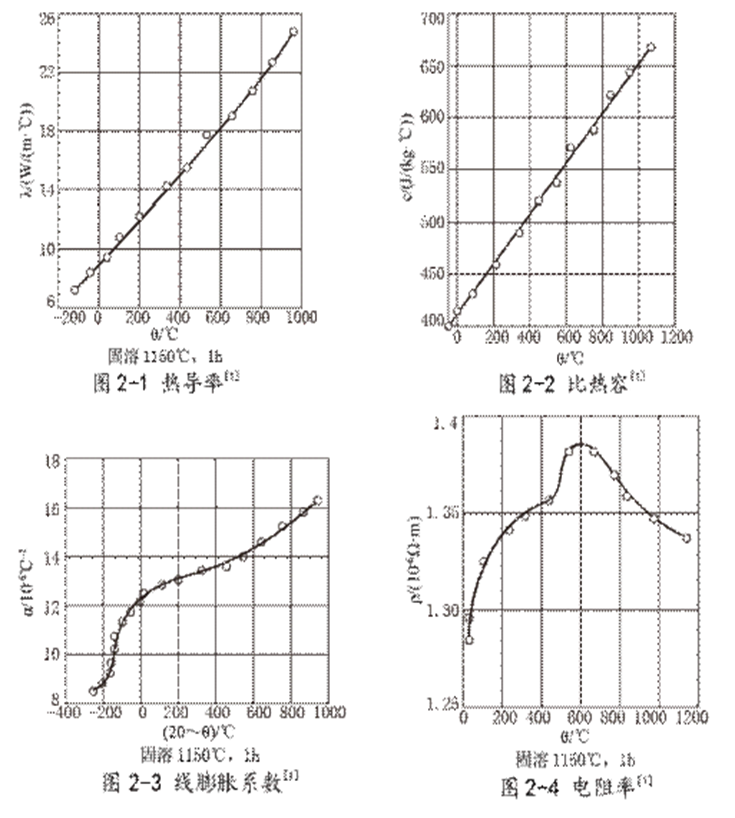
1. Density:ρ=8.44g/cm3
2. Thermal efficiency:
(1). Melting temperature range: 1290~1350℃[1].
(2) Thermal conductivity: See Figure 2-1.
(3) Specific heat capacity: See Figure 2-2.
(4) Linear expansion coefficient: See Figure 2-3.
3. Electrical efficiency:The alloy resistivity is shown in Figure 2-4.
Bar: 950~1030℃, air cooling or water cooling; or 1090~1200℃, air cooling or water cooling solid solution treatment.
Plate: 950~1030℃, air cooling; or 1090~1200℃, air cooling.
Pipe material: Recommended annealing temperature is 960~1030℃, air cooling or water cooling.
5. Inconel625 (NO6625) nickel-based high-temperature alloy variety specifications and supply status:
We can supply d25~80mm rods and 80.8~10.5mm plates, as well as d6~40mm un(welded) pipes. Rods are delivered without heat treatment but in a polished or polished state; plates are supplied after solution and finishing; pipes are supplied after solution and pickling (or bright annealing).
6. Inconel625 (NO6625) nickel-based high-temperature alloy smelting and casting process:
The alloy is produced using vacuum induction furnace melting plus electroslag remelting or vacuum induction furnace plus vacuum arc remelting.
7. Application overview and special requirements of Inconel625 (NO6625) nickel-based high-temperature alloy:
This alloy is used to manufacture parts such as engine casings, guide vanes, mounting edges and barrels, and fuel main pipes. It has passed practical application assessments and has a maximum service temperature of 950°C; the alloy has a certain aging effect after long-term use at 550~700°C. The hardening phenomenon leads to some decrease in the plasticity of the alloy.
1. Application fields:
Low carbon alloy 625 after soft annealing is widely used in the chemical process industry. Its good corrosion resistance and high strength enable it to be used as thin structural components. Alloy 625 can be used in applications where it is exposed to seawater and is subject to high mechanical stress. Typical application areas:
(1) Parts of organic chemical processes containing chloride, especially when acidic chloride catalysts are used;
(2) Digesters and bleaching tanks used in the pulp and paper industry;
(3) Absorption tower, reheater, flue gas inlet baffle, fan (humidity), agitator, deflector and flue in the flue gas desulfurization system;
(4) Used to manufacture equipment and components used in acidic gas environments;
(5) Acetic acid and acetic anhydride reaction generator;
(6), sulfuric acid condenser.
2. Product features:
(1) It has excellent corrosion resistance against various corrosive media in oxidizing and reducing environments;
(2) Excellent resistance to pitting corrosion and crevice corrosion, and will not cause chloride ion stress corrosion cracking;
(3) Excellent resistance to inorganic acid corrosion, such as nitric acid, phosphoric acid, sulfuric acid, hydrochloric acid and mixed acids of sulfuric acid and hydrochloric acid, etc.;
(4) Excellent resistance to corrosion by various inorganic acid mixed solutions;
(5) When the temperature reaches 40°C, it can show good corrosion resistance in hydrochloric acid solutions of various concentrations;
(6) Good processability and weldability, no post-weld cracking sensitivity;
(7) Manufacturing certification for pressure vessels with wall temperatures between -196 and 450°C;
(8) It is certified by the NACE standard of the American Society of Corrosion Engineers (MR-01-75) and meets the highest standard level VII for use in sour gas environments."
8. Inconel625 (NO6625) nickel-based high-temperature alloy physical and chemical properties:
1. Density:ρ=8.44g/cm3
2. Thermal efficiency:
(1). Melting temperature range: 1290~1350℃[1].
(2) Thermal conductivity: See Figure 2-1.
(3) Specific heat capacity: See Figure 2-2.
(4) Linear expansion coefficient: See Figure 2-3.
3. Electrical efficiency:The alloy resistivity is shown in Figure 2-4.
4. Magnetic properties:The alloy is non-magnetic.
5. Chemical performance:
(1) Anti-oxidation performance of Inconel625: The alloy has excellent resistance to high-temperature oxidation. The weight change of the alloy after cyclic oxidation in air medium at high temperature is shown in the table below:
5. Chemical performance:
(1) Anti-oxidation performance of Inconel625: The alloy has excellent resistance to high-temperature oxidation. The weight change of the alloy after cyclic oxidation in air medium at high temperature is shown in the table below:
| Cycle oxidation time/h | 100 | 200 | 300 | 400 | 500 | 600 | 700 | 800 | |
| weight change /% | 980℃ | +0.086 | +0.065 | +0.065 | +0.048 | +0.021 | - | +0.03 | -0.081 |
| 1095℃ | -0.182 | -1.086 | -3.335 | -5.399 | -6.566 | -10.066 | - | - | |
Note: One cycle of oxidation is heating for 15 minutes and cooling for 5 minutes.
(2) Inconel625 corrosion resistance: The alloy has good seawater corrosion resistance, see the table below. The alloy is also resistant to corrosion from various hot solutions. In addition, it has good resistance to corrosion by nitric acid and phosphoric acid, and is also quite resistant to corrosion by hydrochloric acid heated below the boiling point and low-concentration sulfuric acid.
(2) Inconel625 corrosion resistance: The alloy has good seawater corrosion resistance, see the table below. The alloy is also resistant to corrosion from various hot solutions. In addition, it has good resistance to corrosion by nitric acid and phosphoric acid, and is also quite resistant to corrosion by hydrochloric acid heated below the boiling point and low-concentration sulfuric acid.
| Test days | Specimen type | Weight loss/g | localized corrosion degree | Test days | Specimen type | Weight loss/g | localized corrosion degree |
| in still sea water | In flowing sea water (0.61m/s) | ||||||
| 180 | smooth | 0.05 | none | 180 | smooth | 0.04 | none |
| with gaps | 0.05 | none | with gaps | 0.05 | none | ||
| 365 | smooth | 0.02 | none | 365 | smooth | 0.01 | none |
| with gaps | 0.04 | none | with gaps | 0.02 | none | ||
Note: The smooth specimen refers to a 6.4mm*100mm*300mm flat specimen with a circular weld, which is annealed at 980°C before welding. The specimen with a gap refers to a 32mm fiber washer bolted to the center of the plate. .
9. Mechanical properties of Inconel625 (NO6625) nickel-based high-temperature alloy:
Performance specified by Inconel625 technology standards:
9. Mechanical properties of Inconel625 (NO6625) nickel-based high-temperature alloy:
Performance specified by Inconel625 technology standards:
| variety | Tensile properties | Lasting performance | hardness | ||||||
| θ/℃ | σb/MPa | σP0.2/MPa | δ5/% | θ/℃ | σ/MPa | t/h | δ5/% | ||
| no less than | no less than | ||||||||
| Bar ① | 20 | 830 | 410 | 30 | 815 | 114 | twenty three | 15 | HB≤290 |
| Plate ② | 20 | 830 | 410 | 30 | 815 | 114 | twenty three | 15 | HV≤305 |
| Rod | 20 | 830 | 410 | 30 | Q/3B 4078-1992 | - | |||
| plate | 20 | 825 | 415 | 30 | Q/3B 4077-1992 | - | |||
| pipes | 20 | 825 | 415 | 35 | Q/3B 4080-1992 | HRC≤25 | |||
①Standard Z9-0105-1990. ② Standard Z9-0104-1990 and GJB 3317-1998.
10. Inconel625 (NO6625) nickel-based high-temperature alloy structure:
1. Inconel625 phase transition temperature;
2. Inconel625 time-temperature-structure transformation curve;
3. Inconel625 alloy structure: The structure of the alloy in the solid solution state is an austenite matrix and a small amount of TiN, NbC, and M6C phases. After long-term aging at 650~900°C, the precipitated phases are γ”, δ, and M23C6 and M6C. After long-term aging at 650~700℃, γ"is mainly precipitated, which significantly improves the room temperature and high temperature strength of the alloy, and the plasticity is reduced, but still maintains a high level; after aging at 780~850℃, δ phase is mainly precipitated, although the strength There is an improvement, but the plasticity of the alloy decreases a lot. After aging at 900°C, there is only a small amount of precipitated phase, so the mechanical properties are similar to those in the solid solution state. The δ phase is an orthorhombic structure lamellar Ni3Nb and exists in the form of acicular Widmansite structure [1,7].
11. Inconel625 (NO6625) nickel-based high-temperature alloy process performance and requirements:
1. Inconel625 forming efficiency:
The alloy has good cold and hot forming properties. The heating temperature for steel ingot forging is 1120℃, the starting forging temperature is not lower than 1030℃, and the stopping temperature is not lower than 930℃; during die forging, the final deformation should not be less than 15%~20%. The rolling heating temperature is 1120~1160℃, the rolling start temperature is not lower than 1050℃, the rolling stop temperature is not lower than 930℃, the deformation of the thin cold rolled semi-finished product is 25%~30%, and the deformation of the finished product is not less than 30%. The quenching temperature of intermediate and finished products is 1100℃±10℃[1.8].
2. Inconel625 welding performance:
The alloy has good welding performance. It can be arc welded with tungsten electrode or this alloy as additive under protective atmosphere. It can also be used for welding connection and resistance welding.
3. Inconel625 parts heat treatment process:
Stress relief: 900℃; Annealing: 930~1040℃, 1h; Solution treatment: 1090~1200℃, air cooling or water cooling. When the alloy is operated at no higher than 650°C, hot rolled, cold rolled or annealed materials can be used as required. When the working temperature is above 650°C, the annealing process can be used for parts that require better fatigue performance and tensile strength, and the solution treatment can be used for parts that require better creep and durable performance.
4. Inconel625 surface treatment process:
When removing the oxide scale on the alloy surface, it is first washed and then pickled in a nitric acid-hydrofluoric acid-aqueous solution.
5. Inconel625 cutting and grinding performance:
Carbide or high speed steel cutting tools should be used. The cutting tools used should have a positive rake angle. Water-based coolant is recommended for high-speed cutting, and thicker coolant is recommended for low-speed cutting.
12. Varieties, specifications and supply status of Inconel625 (NO6625):
Shanghai Disheng Special Alloy can produce various specifications of Inconel 625 seamless pipes, Inconel 625 steel plates, Inconel 625 round steel, Inconel 625 forgings, Inconel 625 flanges, Inconel 625 rings, Inconel 625 welded pipes, Inconel 625 steel strips, Inconel 625 wire and supporting welding materials.
10. Inconel625 (NO6625) nickel-based high-temperature alloy structure:
1. Inconel625 phase transition temperature;
2. Inconel625 time-temperature-structure transformation curve;
3. Inconel625 alloy structure: The structure of the alloy in the solid solution state is an austenite matrix and a small amount of TiN, NbC, and M6C phases. After long-term aging at 650~900°C, the precipitated phases are γ”, δ, and M23C6 and M6C. After long-term aging at 650~700℃, γ"is mainly precipitated, which significantly improves the room temperature and high temperature strength of the alloy, and the plasticity is reduced, but still maintains a high level; after aging at 780~850℃, δ phase is mainly precipitated, although the strength There is an improvement, but the plasticity of the alloy decreases a lot. After aging at 900°C, there is only a small amount of precipitated phase, so the mechanical properties are similar to those in the solid solution state. The δ phase is an orthorhombic structure lamellar Ni3Nb and exists in the form of acicular Widmansite structure [1,7].
11. Inconel625 (NO6625) nickel-based high-temperature alloy process performance and requirements:
1. Inconel625 forming efficiency:
The alloy has good cold and hot forming properties. The heating temperature for steel ingot forging is 1120℃, the starting forging temperature is not lower than 1030℃, and the stopping temperature is not lower than 930℃; during die forging, the final deformation should not be less than 15%~20%. The rolling heating temperature is 1120~1160℃, the rolling start temperature is not lower than 1050℃, the rolling stop temperature is not lower than 930℃, the deformation of the thin cold rolled semi-finished product is 25%~30%, and the deformation of the finished product is not less than 30%. The quenching temperature of intermediate and finished products is 1100℃±10℃[1.8].
2. Inconel625 welding performance:
The alloy has good welding performance. It can be arc welded with tungsten electrode or this alloy as additive under protective atmosphere. It can also be used for welding connection and resistance welding.
3. Inconel625 parts heat treatment process:
Stress relief: 900℃; Annealing: 930~1040℃, 1h; Solution treatment: 1090~1200℃, air cooling or water cooling. When the alloy is operated at no higher than 650°C, hot rolled, cold rolled or annealed materials can be used as required. When the working temperature is above 650°C, the annealing process can be used for parts that require better fatigue performance and tensile strength, and the solution treatment can be used for parts that require better creep and durable performance.
4. Inconel625 surface treatment process:
When removing the oxide scale on the alloy surface, it is first washed and then pickled in a nitric acid-hydrofluoric acid-aqueous solution.
5. Inconel625 cutting and grinding performance:
Carbide or high speed steel cutting tools should be used. The cutting tools used should have a positive rake angle. Water-based coolant is recommended for high-speed cutting, and thicker coolant is recommended for low-speed cutting.
12. Varieties, specifications and supply status of Inconel625 (NO6625):
Shanghai Disheng Special Alloy can produce various specifications of Inconel 625 seamless pipes, Inconel 625 steel plates, Inconel 625 round steel, Inconel 625 forgings, Inconel 625 flanges, Inconel 625 rings, Inconel 625 welded pipes, Inconel 625 steel strips, Inconel 625 wire and supporting welding materials.
| Variety classification | delivery status | ||||||||||||
| Seamless tube | Solid solution + acid white, length can be customized | ||||||||||||
| plate | Solid solution, pickling, trimming | ||||||||||||
| welded pipe | Solid solution acid whitening + RT% flaw detection | ||||||||||||
| Forgings | Annealing + polishing | ||||||||||||
| Rod | Forged state, surface polished or polished | ||||||||||||
| strip | Cold rolled, solid solution soft state, descaled delivery | ||||||||||||
| wire material | Delivered in solid solution pickled disc shape or straight strip shape, solid solution straight strip in fine polished state | ||||||||||||
| Note: Inconel™ is a registered trademark of Specialty Metals Group, Inc. | |||||||||||||
Recommend Products


